ASO vs SEO: How Mobile App Teams Should Actually Prioritize
ASO vs SEO explained side by side. Compare ranking factors, keyword intent, measurement, and workflows so mobile teams know which channel to invest in.

The popular advice is to pick one channel, usually ASO at launch and SEO later, then treat the handoff as complete. That framing is too simple for how people find apps now. A user might discover a product through a web search, compare alternatives on a landing page, open an App Store listing, and decide based on screenshots, reviews, and store-page relevance.
ASO and SEO aren't rival versions of the same job. SEO captures demand across the open web. ASO converts and expands demand inside app marketplaces. The right allocation changes with the app's stage, category, audience, and measurement quality.
| Dimension | ASO | SEO |
|---|---|---|
| Primary surface | Apple App Store and Google Play | Google, Bing, and other web search engines |
| Main job | Improve app-store visibility and install conversion | Earn qualified web discovery and route users toward the product |
| Searcher mindset | Often close to choosing an app | Can range from research to comparison to purchase intent |
| Core assets | Store metadata, icon, screenshots, previews, ratings, and reviews | Web pages, technical infrastructure, content, internal links, and authority |
| Feedback loop | Store-page performance and install behavior | Rankings, impressions, clicks, engagement, and assisted conversions |
| Best strategic role | Conversion layer and brand defense | Discovery layer and demand capture |
App marketplaces became commercially important enough for ASO to move beyond a specialist tactic. App store spending reached $167 billion in 2022, accounting for more than 33% of mobile app market revenue, while Statista recorded U.S. App Store download conversion at 30% in the first half of 2023, compared with 31.3% on Google Play. Those figures, reported in app store optimization market data from Business of Apps, show why the store page deserves serious growth ownership.
SEO operates at a much broader scale. Google processes more than 40,000 queries per second and holds about 91.38% of global search engine market share, while 68% of online experiences begin with a search engine, according to the search-discovery framework from First Page Sage. A mobile team shouldn't ignore that surface because the final transaction happens in an app store.
The practical model has three stages: validate demand before and around launch, build repeatable acquisition during growth, and defend the brand while supporting retention and reactivation. ASO and SEO participate in all three, but their budget priority shifts.
Table of Contents
- The Real Question Behind ASO vs SEO
- What ASO and SEO Actually Do
- Ranking Factors and Click Behavior Compared
- Keyword Intent, Measurement, and KPIs
- Where Each Channel Wins for Mobile App Teams
- Building an Integrated ASO and SEO Workflow
- How to Decide Your Channel Mix
- Why the Answer Is Integration Not Choice
<a id="the-real-question-behind-aso-vs-seo"></a>
The Real Question Behind ASO vs SEO
The question isn't “Which channel wins?” It's where does the next useful interaction happen, and which channel can improve it?
ASO and SEO share a search-based operating logic. Both start with user language, match that language to a relevant result, and rely on engagement or trust signals to reinforce visibility. Their economics differ because the environments differ. App stores control the listing, the install action, and much of the immediate conversion path. The web offers broader discovery, but a web visitor may still need education, comparison, trust-building, and a deliberate handoff to the store.
That distinction changes how teams interpret performance. A weak store-page conversion rate can make strong ASO visibility commercially useless. A successful SEO program can bring highly relevant visitors but fail to create installs if the website has no clear store route, weak product explanation, or inconsistent messaging.
Operating principle: Fund the channel that improves the next funnel step, not the channel with the more familiar acronym.
At validation and launch, the store listing is usually the fastest place to test whether the product promise matches user expectations. The team can refine the title, subtitle or description, screenshots, and positioning while watching store impressions, listing visits, and installs. SEO still matters for validating language and building a credible web presence, but it usually has more assets to establish before it can capture broad non-branded demand.
At growth, SEO can expand the addressable discovery surface through product pages, comparison content, help resources, and use-case pages. ASO remains responsible for converting store traffic and improving visibility for category searches, but the team should connect web discovery to store outcomes instead of reporting both channels in isolation.
At retention and reactivation, ASO protects branded discovery inside the marketplace. SEO supports the surrounding ecosystem, including troubleshooting content, feature education, release information, and pages that answer questions before a user abandons the product.
The strategic error is sequencing channels as substitutes. The better approach sequences jobs. SEO helps more people understand why the app is relevant. ASO helps them choose it when they reach the store.
<a id="what-aso-and-seo-actually-do"></a>
What ASO and SEO Actually Do
App Store Optimization improves an app's ability to appear and convert within Apple's App Store and Google Play. The work includes search-oriented metadata, category positioning, localized copy, icons, screenshots, preview assets, ratings, reviews, and signals connected to install and post-install quality.
Search Engine Optimization improves a website's ability to appear in general search engines. The work includes page relevance, content structure, technical accessibility, page experience, internal linking, digital authority, and the connection between search demand and a useful destination.
The symmetry is useful, but it shouldn't hide the boundary between the two:
- ASO optimizes a product listing. The listing has limited space and must communicate value quickly through text and visuals.
- SEO optimizes a web ecosystem. The site can support many pages, answer multiple intents, and introduce people to the product before they know which app they want.
- ASO closes a store decision. The user is already inside an environment designed for discovery, evaluation, and installation.
- SEO creates or captures demand. The user might be looking for a solution, an explanation, a comparison, or a known brand.
Both channels need disciplined keyword research. A phrase that describes a user problem can inform an SEO article, a landing page, an App Store subtitle, a Google Play description, and screenshot messaging. Teams lose efficiency when separate specialists build disconnected keyword lists and then publish contradictory promises.
The algorithms also evaluate different forms of confidence. In ASO, ratings, reviews, install behavior, listing relevance, and creative clarity influence whether a visitor trusts the app enough to install. In SEO, content usefulness, technical quality, links, and broader authority help a page earn visibility. The exact ranking systems aren't fully transparent, so a responsible program tests outcomes rather than treating any checklist as a guaranteed formula.
ASO also benefits from the store's native conversion mechanics. SEO doesn't provide that same built-in path. A web page must earn the click, explain the product, handle objections, and direct the visitor to the appropriate store or deep link.
The shared asset is intent. The store listing and the website should use the user's language consistently, but each surface should perform the job its environment makes possible.
<a id="ranking-factors-and-click-behavior-compared"></a>
Ranking Factors and Click Behavior Compared
Ranking and conversion shouldn't be discussed as one metric. A result can rank well and convert poorly, or convert strongly while receiving too little exposure. ASO and SEO separate those problems differently because users scan store results and web results under different conditions.
For ASO, teams typically work on the app title, subtitle or short description, keyword field where applicable, full description, creative assets, ratings, reviews, and signals associated with installs and engagement. Store events and update communication can also support relevance and re-engagement. The listing has to win both the relevance test and the rapid visual evaluation.
SEO has a wider technical and editorial surface. Teams optimize page titles, headings, content depth, internal links, crawlability, structured presentation, site performance, and authority earned through relevant external references. A web result can also answer a more exploratory question than an app-store result, which makes content architecture central to the channel.
The click curves reveal an important economic difference. In Google organic results, the first position averages 27.6% CTR, followed by 15.8% for position two and 11.0% for position three, according to organic search benchmarks from Benchmarketing. Moving from position three to position one can therefore produce a much larger traffic change than a simple one-position improvement suggests.
That doesn't mean every web query behaves identically. It means SEO teams should model rank movement as a nonlinear traffic opportunity, especially for commercially valuable queries. Lower positions can still contribute through long-tail coverage, brand reinforcement, and assisted conversions, but the immediate click yield is usually more limited.
App-store search behaves more like a high-intent conversion environment. Neutral benchmark coverage places average App Store search conversion around 30% to 35%, with strong programs targeting above 12% search CVR and 1.3% or higher browse CVR, as reported by Growth by Kev's conversion benchmarks. These benchmarks shouldn't be treated as universal targets because category, brand strength, traffic source, and measurement definitions vary. They do support a useful conclusion: ASO often has more influence after discovery, while SEO often has more influence before the user reaches the store.
| Dimension | App Store, ASO | Web Search, SEO |
|---|---|---|
| Relevance inputs | Metadata, category fit, listing language, and app signals | Page content, technical accessibility, links, and authority |
| Evaluation surface | Icon, title, screenshots, ratings, reviews, and preview assets | Title, snippet, page experience, content, and site credibility |
| Click behavior | Users often compare a compact set of app listings | Users can scan many result types and refine the query |
| Conversion point | Store listing to install | Search result to site visit, then a later product or store action |
| Primary optimization problem | Turn relevant store exposure into installs | Turn relevant web demand into qualified engagement and downstream action |
| Economic shape | Strong listing changes can affect install conversion quickly | Rank gains can compound, but traffic and install attribution may take longer |
A team that reports only rankings misses the commercial question. A team that reports only installs misses whether the store or the web created the demand. Measure both the exposure curve and the conversion curve.
<a id="keyword-intent-measurement-and-kpis"></a>
Keyword Intent, Measurement, and KPIs
Keyword intent changes as the search surface changes. In an app store, a query such as “budget tracker” may indicate that the user is actively evaluating products. On the web, a related query could be informational, comparative, navigational, or commercial. The user may want a definition, a list of options, a feature explanation, or a specific brand before considering an install.
That difference affects the content brief. ASO metadata must fit a constrained listing and support immediate comprehension. SEO can target a cluster of related questions across multiple pages, then move visitors toward a product page, a store link, or an account flow.
The measurement stack should preserve that distinction rather than force one universal KPI.
| Dimension | ASO | SEO |
|---|---|---|
| Visibility | Store impressions, keyword positions, browse exposure | Search impressions, ranking positions, indexed pages |
| Engagement | Listing views and store-page interaction | Organic sessions, click-through rate, engagement, and page paths |
| Conversion | Store-listing conversion, installs, and qualified install share | Store clicks, sign-ups, assisted conversions, and pipeline contribution |
| Quality | Ratings, review themes, activation, and retention cohorts | Returning visitors, downstream product actions, and assisted revenue |
| Diagnostic question | Did relevant store exposure become a valuable install? | Did relevant web discovery create a useful product interaction? |
App attribution platforms such as AppsFlyer or Adjust can connect installs to acquisition sources, but the path may still be incomplete when a user researches on the web and later searches directly in the store. Search Console can show query and page behavior on the website, yet it won't by itself explain the quality of every resulting install.
A shared keyword master sheet helps expose those gaps. Add the query, intent, market, funnel stage, target surface, current visibility, conversion event, and owner. Then use web queries to challenge ASO assumptions. If Search Console reveals that users describe a feature differently from the store metadata, that language deserves testing in the listing. Store search terms and review language can also inspire SEO pages that answer the questions users ask after installation.
The review cadence should match the signal. ASO teams can monitor store visibility and listing conversion frequently. SEO teams need to evaluate content performance, indexing, and assisted actions over a longer window. The important point isn't forcing identical reporting intervals. It's agreeing on one question: which search demand produced users who reach the product's quality milestones?
<a id="where-each-channel-wins-for-mobile-app-teams"></a>
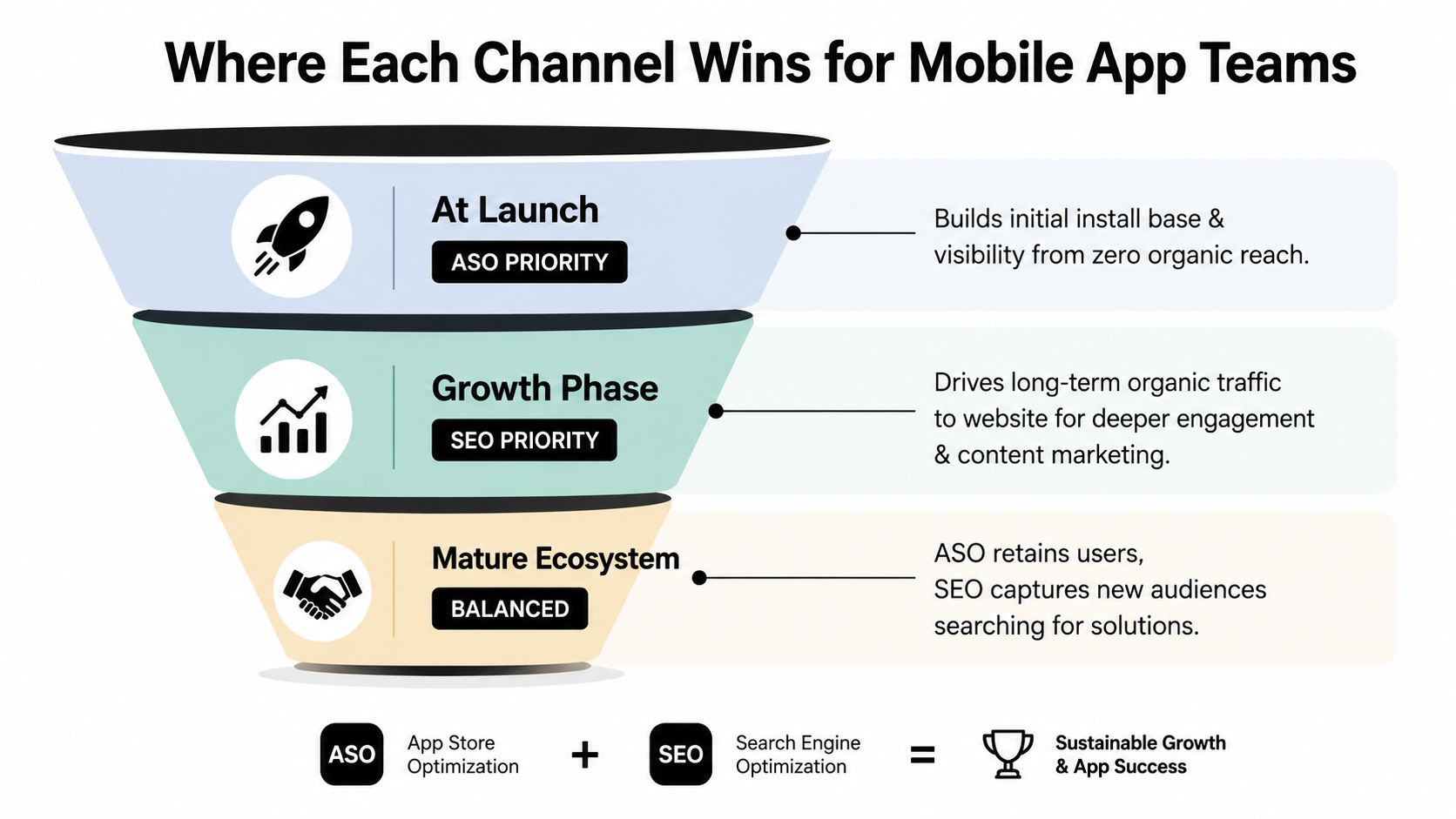
Where Each Channel Wins for Mobile App Teams
A launch team and a mature app team can look at the same keyword and make different investment decisions. The reason isn't that one team understands ASO better. The reason is that each team has a different bottleneck.
<a id="at-launch"></a>
At launch
A new app usually needs a credible store destination before it needs a large publishing operation. ASO can improve the listing's relevance and presentation while the team learns which promise earns attention and installs. The signals to watch include organic install share, listing conversion, review quality, and whether the initial audience reaches activation.
SEO still has a role before launch. A focused website can explain the problem, collect demand, support validation interviews, and give branded searches somewhere useful to land. But a team without a developed content base or established web authority shouldn't assume that broad SEO will solve an immediate install problem.
<a id="during-growth"></a>
During growth
As the store listing becomes more efficient, the next constraint may be discovery outside the marketplace. SEO can target use cases, comparisons, educational questions, and feature-specific searches that a compact store listing can't address. The key signal is not traffic volume alone. It's whether organic visitors click to the store, search for the brand later, sign up, or become users with acceptable activation and retention.
A web page that attracts the right audience can also improve the quality of store visits. The visitor arrives with context instead of encountering the app with no prior understanding.
<a id="in-a-mature-ecosystem"></a>
In a mature ecosystem
A mature app needs brand defense and reactivation as much as new acquisition. ASO helps the official listing remain the obvious result for branded searches and protects the conversion surface from confusion with similar apps. SEO supports help content, feature documentation, release communication, and comparison pages that answer questions throughout the user lifecycle.
Review themes and churn reasons should shape both channels. If users misunderstand a feature, the store screenshots and web explanation should resolve the same objection. That coordination can reduce the gap between acquisition messaging and the experience users expect after installation.
<a id="building-an-integrated-aso-and-seo-workflow"></a>
Building an Integrated ASO and SEO Workflow
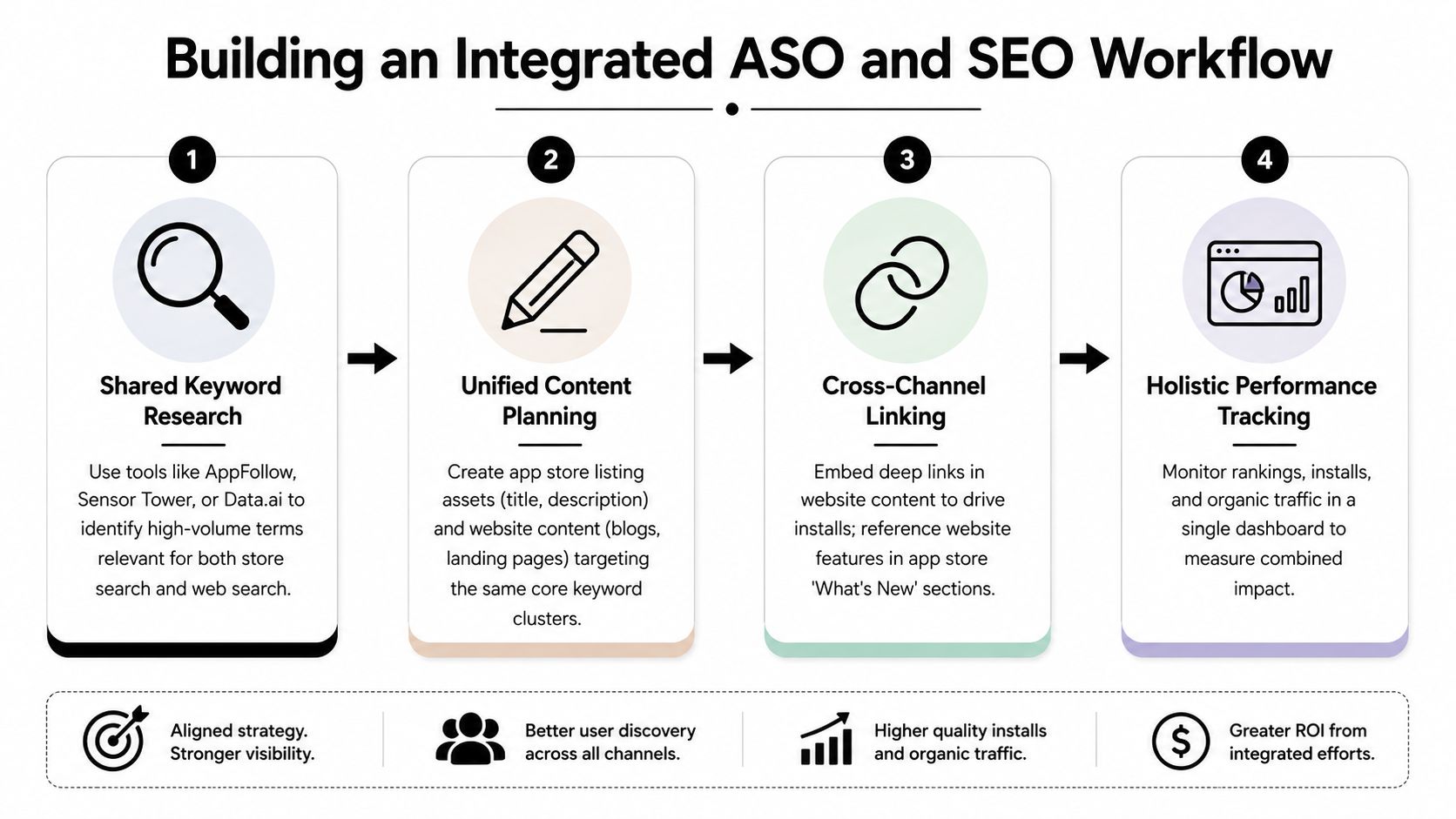
Integration works when the teams share inputs and decisions, not when they place two reports in the same dashboard.
<a id="start-with-one-demand-map"></a>
Start with one demand map
Use ASO tools such as AppFollow, Sensor Tower, or Data.ai alongside Ahrefs, Semrush, and Google Search Console. The goal isn't to crown one tool as authoritative. It's to compare language across the store and web, then classify each query by intent, market, funnel stage, and business value.
Put the findings in one keyword master sheet. Include the current page or listing, the proposed owner, the target conversion event, and the evidence that makes the term relevant. A keyword without a destination or measurement event is a research note, not a growth asset.
<a id="assign-the-work-by-surface"></a>
Assign the work by surface
Product marketing or growth marketing usually owns store metadata, screenshots, icons, and listing experiments. Content and technical marketing typically own website architecture, page briefs, publishing, internal linking, and technical fixes.
Ownership should be distinct, but review shouldn't be siloed. A monthly meeting can compare store-query language with web-query language, review themes, landing-page behavior, and install quality.
<a id="create-explicit-handoffs"></a>
Create explicit handoffs
SEO pages should send users to the correct store through clear, context-matched links. Where the product supports it, deep links and universal links can reduce friction between a web explanation and an app destination.
ASO creatives should reinforce the same product vocabulary used on high-performing pages. A user who arrives after reading about a specific capability shouldn't see screenshots that describe the app in unrelated terms.
<a id="match-cadence-to-the-channel"></a>
Match cadence to the channel
Weekly ASO checks can identify ranking, review, and listing-conversion changes that need attention. SEO content and technical performance deserve regular monitoring, while refresh decisions should be based on query relevance, page behavior, and business outcomes rather than an arbitrary publishing rhythm.
Run a cross-channel audit each quarter. Review which web pages influence branded demand, which store terms produce valuable users, and where attribution breaks. Tools are useful, but the operating system matters more: one demand map, shared conversion definitions, and a clear handoff from discovery to install.
<a id="how-to-decide-your-channel-mix"></a>
How to Decide Your Channel Mix
A channel mix should follow the bottleneck, not a fixed rule such as “ASO first” or “SEO scales better.” Start with three diagnostic inputs:
- Organic install contribution: Determine whether store search and web search are generating meaningful organic installs relative to the rest of acquisition.
- Post-install quality: Compare activation and retention cohorts by source. A high install count doesn't justify more budget if those users fail to reach the product's intended value.
- Web readiness: Assess whether the site has relevant indexed pages, credible authority, useful branded demand, and a path that leads visitors to the app.
Lean toward ASO when the store listing is weak, organic store visibility is limited, and the product already has a clear install-intent audience. Lean toward SEO when the website attracts qualified problem-aware visitors and the app needs education, comparison, or category-level discovery before the store decision.
Use a split when both surfaces show evidence of demand but the handoff is under-measured. This commonly happens during a post-launch optimization cycle, a category expansion, or an international rollout. Don't split budget to appear balanced. Split it when each channel owns a distinct measurable stage.
| Scenario signal | Lean ASO | Lean SEO | Split |
|---|---|---|---|
| Store listing conversion | Weak or inconsistent | Already efficient | Improving, but not yet stable |
| Web demand | Limited or poorly qualified | Relevant pages and clear store routes exist | Strong discovery with unclear install influence |
| Product bottleneck | More qualified store exposure | More education and demand capture | Both reach and conversion need work |
| Quality signal | Stable cohorts justify more acquisition testing | Web users show strong downstream intent | Quality differs by query or landing page |
| Review action | Test metadata and creative assets | Expand content and technical coverage | Coordinate listing and page experiments |
Set kill criteria before publishing or testing. For ASO, retire keywords that remain irrelevant to store visitors or attract poor-quality installs. For SEO, reconsider pages that earn visibility without qualified engagement or downstream product actions. The criteria should reflect the app's business model, not a generic traffic target.
<a id="why-the-answer-is-integration-not-choice"></a>
Why the Answer Is Integration Not Choice
The strongest argument for integration is behavioral. Discovery doesn't respect the reporting boundaries between a website and an app store. Recent coverage on the evolving relationship between ASO and SEO from MobileAction describes how AI Overviews, semantic search, and app-focused web pages can influence app discovery while ASO remains the conversion layer inside stores.
That creates a multi-touch path. A user can discover a product through a web result, learn from a page, return through a branded query, and then install from the store. If the website and listing use different positioning, the handoff creates doubt. If they reinforce the same use case, the second surface benefits from the work performed by the first.
The shift toward semantic matching makes the old exact-keyword debate less useful. Coverage from AppFollow on ASO developments points to a broader evaluation of intent, engagement, retention, and review velocity. The practical implication is that install quality matters more than installs in isolation. A keyword that generates volume but weak activation may be less valuable than a narrower term that attracts users who keep using the app.
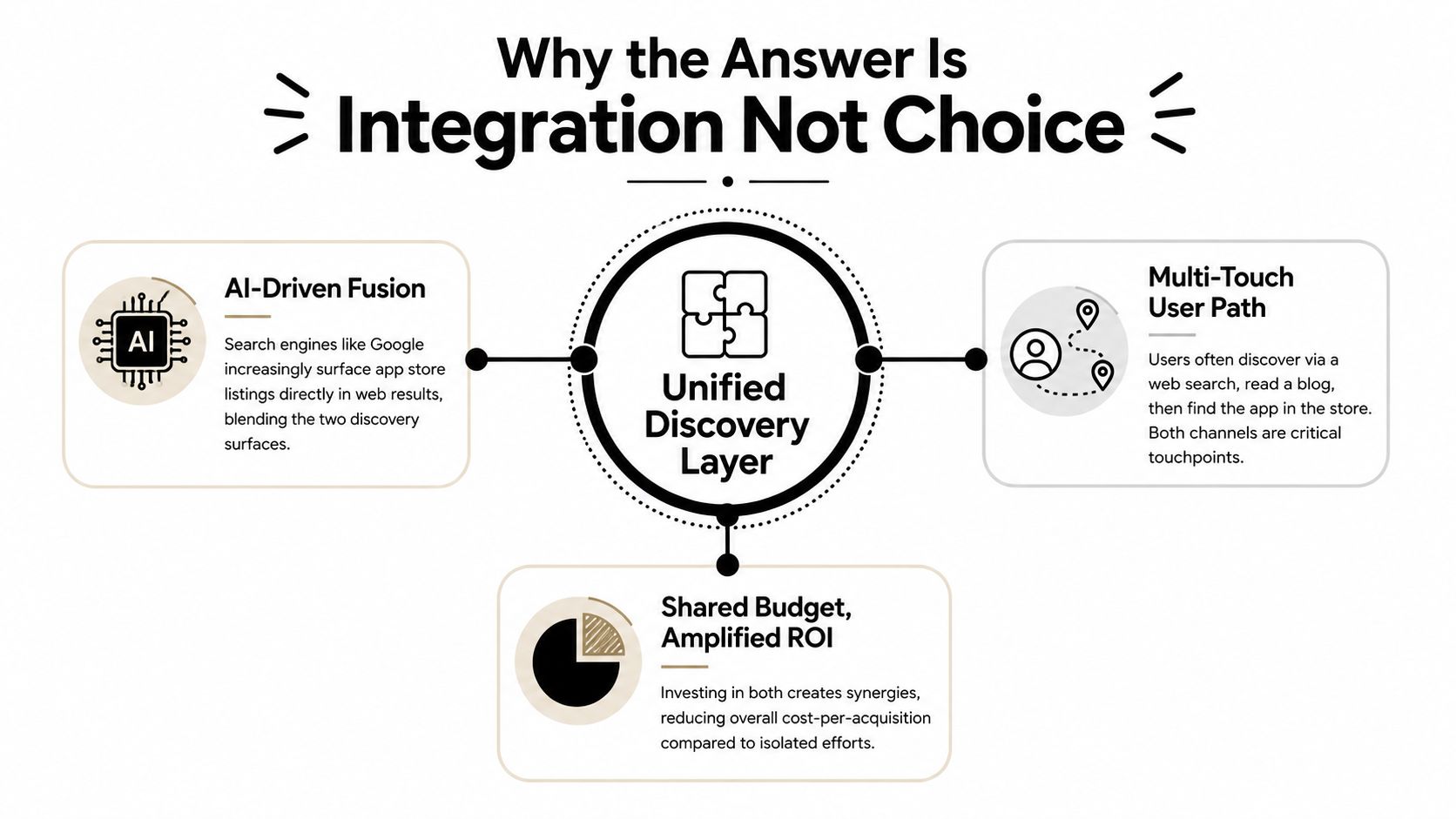
SEO and ASO should therefore share a growth pod, even when specialists retain separate responsibilities. Share keyword research, conversion definitions, review insights, store outcomes, and content priorities. Use a unified attribution model where possible, and label the gaps instead of pretending every assist can be assigned perfectly.
The defensible decision is stage-dependent channel allocation with permanent channel integration. At launch, ASO may deserve more attention because the store listing is the immediate conversion surface. During growth, SEO may deserve more investment because it expands discovery beyond constrained store metadata. In every stage, the architecture should connect the two.
LetsDeployIt helps React Native and Expo teams prepare app store listings, ASO keywords, screenshots, icons, compliance materials, reviewer notes, and end-to-end submissions for Apple App Store and Google Play. If your growth plan depends on a store page that is ready to convert the demand your SEO program creates, visit LetsDeployIt to review the launch service and submission options.