10 Web App Privacy Policy Generator Picks for 2026
Compare 10 web app privacy policy generator tools by features, pricing models, customization, hosting, integrations, and legal-review needs.

The most popular advice about a web app privacy policy generator is also the most incomplete: answer a questionnaire, publish the resulting URL, and move on. That creates a document, not necessarily a policy that matches your application.
A web app can collect information through authentication, payments, analytics, error reporting, advertising, customer-support tools, embedded content, and third-party SDKs. Your choice of generator should reflect those data practices, the regions where users live, the clauses your business needs, and whether you'll host the policy yourself or rely on a provider-managed page. You also need to decide whether cookie consent, preference management, and data-subject request workflows belong in the same product.
This comparison evaluates each tool through a launch workflow: data-practice fit, clause depth, hosting and integration effort, update responsibility, consent requirements, and readiness for product launches. The list starts with broad compliance suites, moves through lightweight document generators, and ends with a developer-focused app tool. After the picks, you'll find practical checks for aligning your policy with analytics, SDKs, permissions, consent systems, and store disclosures.
A generated policy can accelerate launch preparation. It can't tell you what your app does unless you provide accurate information, and it can't replace legal advice when your processing is complex or your risk is high.
Table of Contents
- 1. Termly Privacy Policy Generator
- 2. iubenda Privacy and Cookie Policy Generator
- 3. TermsFeed Privacy Policy Generator
- 4. GetTerms Privacy Policy Generator
- 5. PrivacyPolicies.com Privacy Policy Generator
- 6. FreePrivacyPolicy.com
- 7. Enzuzo Privacy Policy Generator and CMP
- 8. Termageddon Auto-Updating Policies
- 9. CookieYes Privacy and Cookie Policy Generators
- 10. App Privacy Policy Generator by Nisrulz
- Top 10 Web App Privacy Policy Generators, Feature Comparison
- Choose the Generator That Matches Your Launch Risk
<a id="1-termly-privacy-policy-generator"></a>
1. Termly Privacy Policy Generator
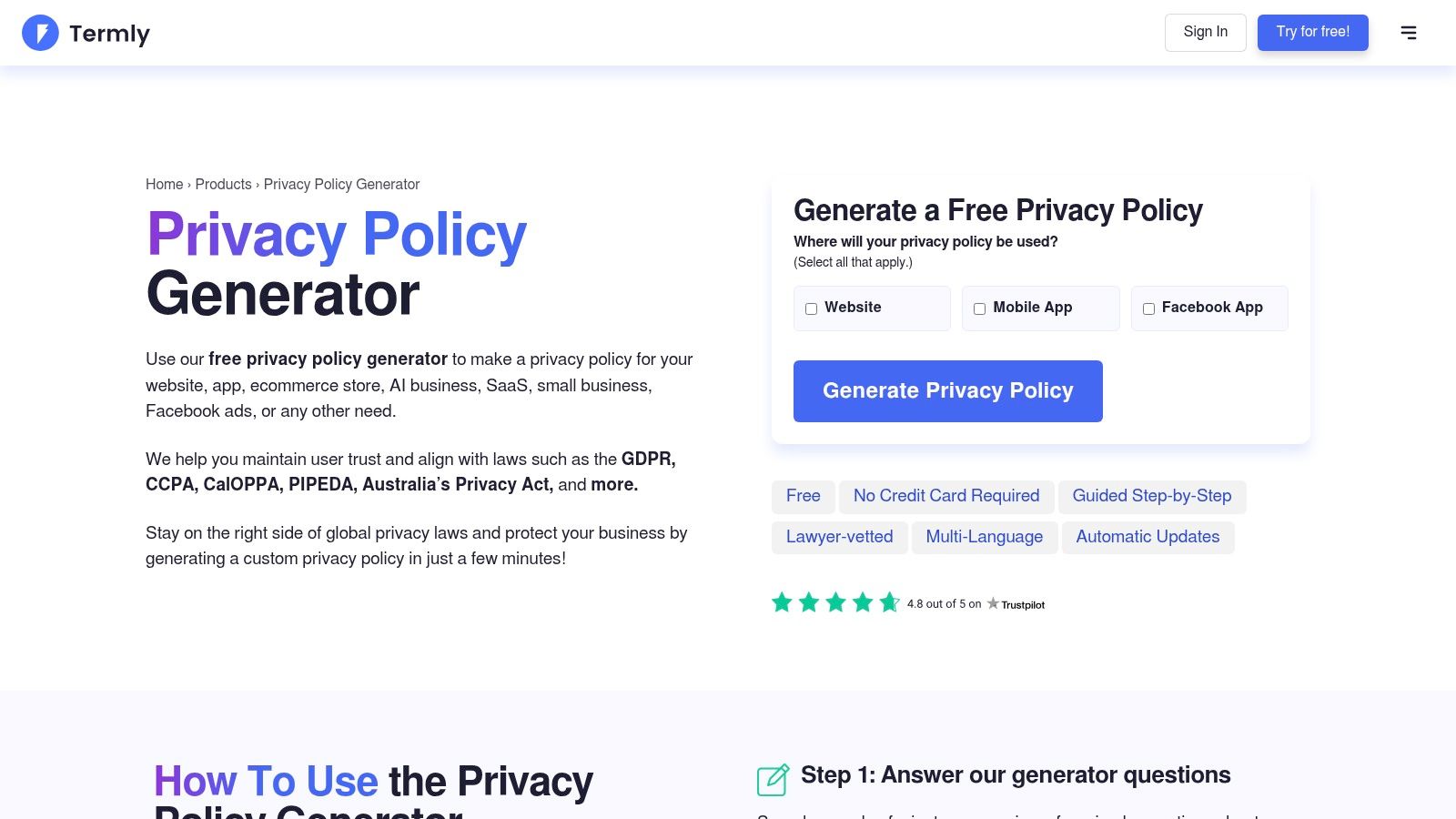
Termly's Privacy Policy Generator suits teams that want policy creation and cookie consent in one dashboard. Its guided questionnaire is accessible to non-technical founders, while the service maintains legal updates through its legal team. You can publish a hosted policy or copy and download the result for your own site.
That combination matters during a web app launch. A hosted page reduces deployment work, while downloadable formats give developers control over routing, branding, and versioning. Termly also supports cookie consent management and Google Consent Mode v2, which makes it more useful than a stand-alone document tool when marketing tags and analytics are part of the launch.
<a id="best-fit-and-trade-offs"></a>
Best fit and trade-offs
Termly is a practical middle ground for small businesses, SaaS teams, and indie developers with familiar data flows. The same dashboard can hold policies and cookie consent settings, so the team doesn't have to stitch together separate tools immediately.
The trade-off appears when the application needs unusual clauses or a highly customized explanation of data processing. Advanced functionality, branding removal, and some integrations require paid plans. Before choosing it, confirm that the selected plan supports your domains, policy hosting approach, and consent configuration.
Practical rule: Treat the questionnaire as an inventory exercise. Confirm every analytics, advertising, payment, support, and authentication service before publishing the generated policy.
Termly works best when one person owns both the document and the consent configuration. If developers later add a tracker without updating either system, the dashboard won't automatically make the application's real behavior accurate.
<a id="2-iubenda-privacy-and-cookie-policy-generator"></a>
2. iubenda Privacy and Cookie Policy Generator
iubenda takes a modular approach. Instead of treating a privacy policy as one broad template, it builds the document from service-aware, lawyer-crafted clauses. You identify the services and SDKs used by the web app, and the tool can add disclosures that correspond to those processing activities.
That structure is valuable for applications with several vendors, multiple markets, or frequent technology changes. Multilingual documents and white-label options also make it suitable for agencies and companies launching products across regions. Hosting and embedding options reduce the effort required to place the policy in a public, stable location.
<a id="clause-depth-versus-operating-cost"></a>
Clause depth versus operating cost
The strength of iubenda is also its main cost. A clause-based system can represent a complicated stack more precisely than a short, generic questionnaire, but it requires more careful configuration. Someone must know which services the app uses and understand whether the selected clauses describe actual behavior.
Per-site or per-app licensing can become expensive as a portfolio expands. The broader feature set may also feel excessive for a prototype with a single sign-in form and minimal analytics. For a mature web app, however, the additional structure can make policy maintenance easier to manage than repeatedly editing a static document.
A useful implementation sequence is:
- Inventory services first: List authentication, payments, analytics, advertising, hosting, monitoring, support, and communication providers.
- Map processing purposes: Separate essential account functions from measurement, personalization, marketing, and fraud prevention.
- Review language manually: Check that the generated clauses explain your product rather than merely naming vendors.
iubenda is a strong choice when the policy must support a changing, international product. It isn't the fastest route to a basic URL, but it offers a more deliberate workflow for teams that expect their data practices to grow.
<a id="3-termsfeed-privacy-policy-generator"></a>
3. TermsFeed Privacy Policy Generator
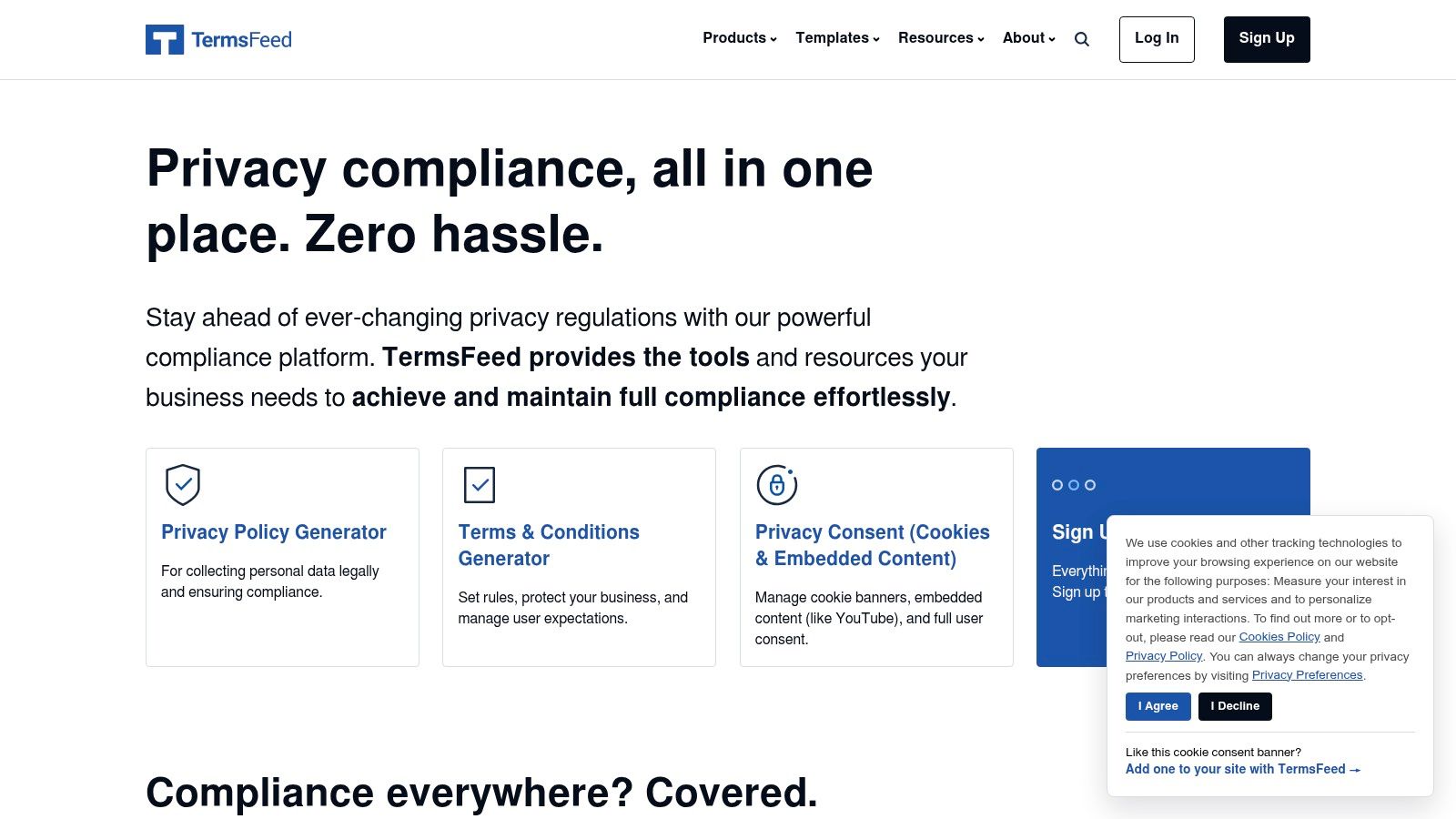
TermsFeed is built for straightforward policy production across websites, SaaS products, and apps. Its free generator provides a quick starting point, while paid add-ons cover regulatory and service-specific needs such as analytics, advertising, payments, GDPR, and CCPA/CPRA-related disclosures.
The platform supports several policy types, including Terms and Conditions, Cookie Policies, EULAs, and disclaimers. You can host a policy through TermsFeed or download it for deployment on your own domain. That choice is useful for developers who want a permanent external page during a launch but prefer self-hosting later.
<a id="where-it-works-well"></a>
Where it works well
TermsFeed's main advantage is clarity. The setup is relatively quick, and the one-time purchase model for many add-ons can make budgeting easier than an ongoing subscription. Its platform-specific hosting instructions also help when a team needs to publish a policy without adding a new deployment task to the sprint.
The limitation is customization depth. Compared with a more modular service, TermsFeed may require more judgment when your application uses an unusual combination of processors, data categories, or consent flows. Add-ons can also accumulate as the product expands into new regions or adopts more third-party services.
A developer should compare the generated result against the deployed application before accepting it. Check the names and purposes of every tool, the categories of user information, retention language, rights instructions, and contact details. A clean policy URL isn't evidence that those details are correct.
TermsFeed is a sensible fit for a web app that needs a credible document quickly and can maintain its own technology inventory. It becomes less attractive when the team wants continuous mapping between a live stack and a policy without assigning someone responsibility for updates.
<a id="4-getterms-privacy-policy-generator"></a>
4. GetTerms Privacy Policy Generator
GetTerms suits teams that need a policy page quickly without adopting a larger compliance platform. Its questionnaires cover websites, apps, and SaaS products, with options addressing GDPR, UK GDPR, CCPA, and PIPEDA. The questions focus on practical data practices, so a developer can describe the product and produce a document without configuring an extensive compliance workspace.
That speed helps during an early web-app launch, especially when the product needs a public policy URL for its footer, account settings, sign-up flow, or support area. You can copy or download the policy, while paid plans can remove branding. Hosting is therefore straightforward, whether the team publishes the page inside its own application or uses the generated output elsewhere.
<a id="where-the-shortcut-ends"></a>
Where the shortcut ends
GetTerms creates policy text, not an operating layer for privacy compliance. It provides fewer deep integrations and less advanced tooling than broader suites. The team may still need separate systems for cookie consent, scanning, data-subject requests, processor inventories, and change tracking.
That trade-off is reasonable for a prototype or small app with limited collection and a short list of known services. It becomes harder to justify once the application adds advertising, profiling, multiple analytics tools, or region-specific consent rules. In those cases, the generator cannot verify whether production behavior matches the answers in the questionnaire.
Before publishing, compare each clause with the deployed stack. Confirm the services and their purposes, information categories, retention wording, rights instructions, contact details, and consent behavior. A clean policy page does not prove that the underlying data flows are documented accurately.
GetTerms is a practical fit when one person owns the technology inventory and will revisit the document after material changes. Choose another approach when the launch requires automatic discovery, consent coordination, or continuous policy updates. Professional legal advice is appropriate when processing is high-risk, the product handles sensitive information, or the applicable regional obligations are unclear.
<a id="5-privacypoliciescom-privacy-policy-generator"></a>
5. PrivacyPolicies.com Privacy Policy Generator
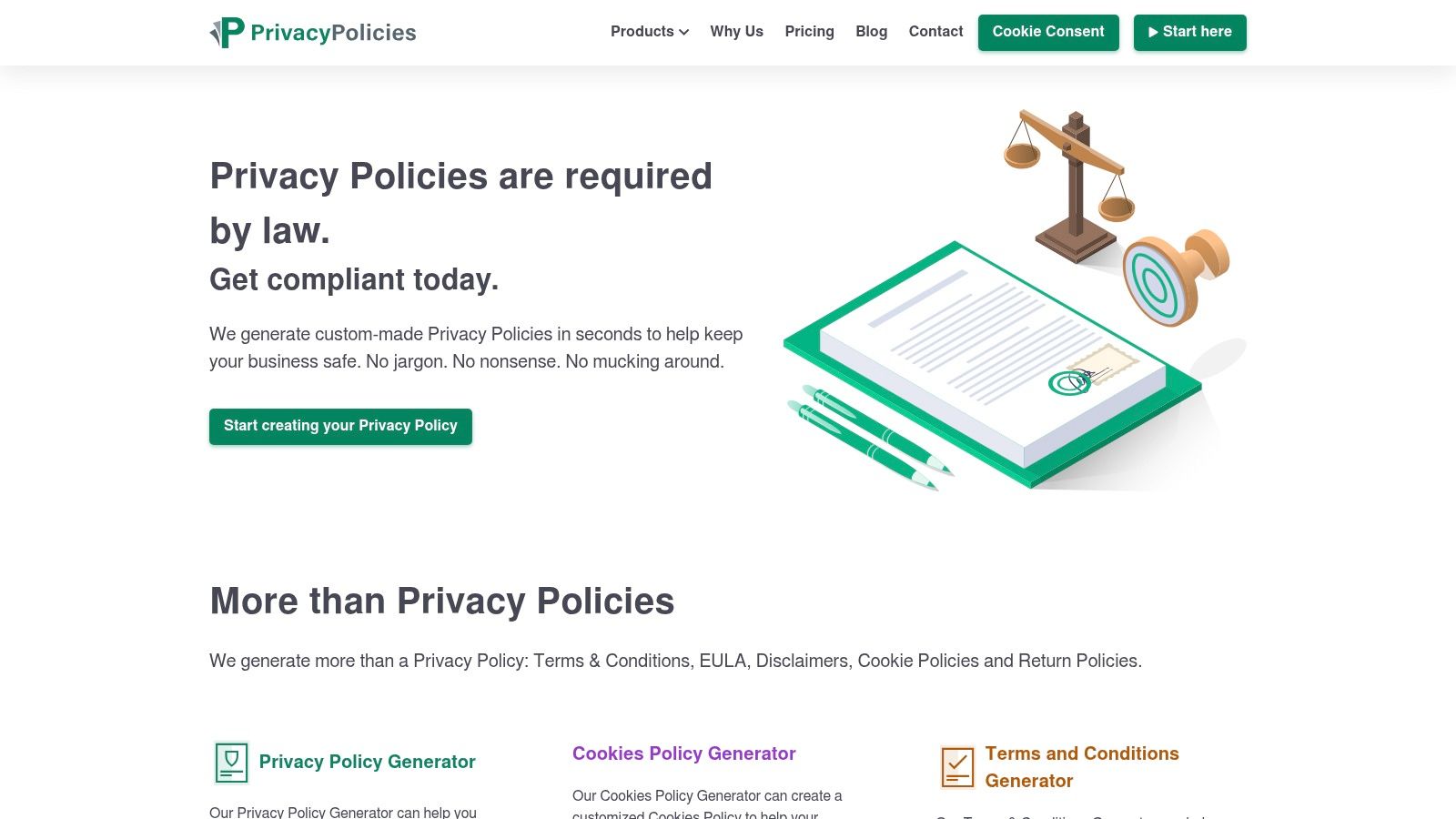
A generated policy can be published quickly, but the launch team still owns the accuracy and maintenance work. PrivacyPolicies.com combines a guided generator with hosted pages and optional one-time add-ons. It covers websites and mobile apps, and can also produce documents such as Terms, Cookie Policies, and EULAs. That range is useful when a product needs several legal pages during launch.
The free hosted option solves a practical deployment problem: the app can link to a public policy URL without adding a new page to its codebase. Premium outputs and downloads give the team more control over self-hosting, branding, and migration. Hosting is convenient, though the account owner should be recorded so the policy does not depend on one developer's credentials.
<a id="fit-the-document-to-the-release"></a>
Fit the document to the release
PrivacyPolicies.com offers add-ons for GDPR, CPRA/CCPA, CalOPPA, and service-specific clauses. A small product can begin with a narrower document, then select additional coverage as it adds regions or vendors. That flexibility also creates a cost and governance trade-off. Each new selection should be tied to an actual data practice, not chosen as a substitute for review.
The simpler questionnaire makes setup less intimidating than iubenda's clause-oriented approach. It may provide less operational direction for a complex web app, however. Before launch, compare the answers with network requests, database fields, cookies, SDKs, vendor contracts, retention rules, and consent behavior. Confirm that the hosted URL is stable and suitable for app-store or product-launch requirements.
Assign an owner and document how the policy will be updated or migrated. Recheck it after adding an SDK, changing analytics, introducing advertising, or entering a new market. The generator creates the document, while the team remains responsible for keeping production behavior aligned with it.
PrivacyPolicies.com suits teams that prefer one-time purchasing, hosted delivery, and several document types. Professional legal advice is warranted when processing is high-risk, sensitive information is involved, or regional obligations are unclear.
<a id="6-freeprivacypolicycom"></a>
6. FreePrivacyPolicy.com
FreePrivacyPolicy.com suits teams that need a basic privacy policy without adopting a broader compliance suite. Its guided flow covers websites and apps, while the finished document can be copied, downloaded, or self-hosted. The service also offers related documents, such as Terms and Conditions.
Its generator service dates to 2016 and advertises HTML, DOCX, and plain text formats. That range makes the output easier to place in a repository, host at a stable route, or adapt for a product launch than a document that only exists inside the generator.
<a id="a-practical-baseline-for-narrow-data-practices"></a>
A practical baseline for narrow data practices
For a prototype, side project, or minimum viable product, the questionnaire can produce a usable starting document quickly. A developer can publish a policy URL without adding a separate legal-content workflow to the application.
The trade-off appears as the app grows. Complex SDKs, targeted advertising, extensive user profiles, international processing, and demanding consent requirements may require more clause control and operational tooling than a basic generator provides. It does not manage consent or continuously verify that the live application matches the policy.
Treat the generated document as a launch baseline, then check it against the product:
- Read every section: Remove assumptions that do not describe the app.
- Add your vendors: Account for analytics, payment, email, support, hosting, and monitoring services.
- Publish under a controlled URL: Keep the route stable and place it where users, reviewers, and launch platforms can find it.
- Create a change trigger: Revisit the policy after code, SDKs, permissions, data uses, or business models change.
Assign someone to own those reviews. A generator can shorten initial drafting, while the team remains responsible for consent configuration, disclosures, and ongoing accuracy. Professional legal advice is appropriate when the app handles sensitive information, uses high-risk processing, serves multiple regions, or faces unclear obligations.
FreePrivacyPolicy.com works best when the data footprint is narrow and the team accepts that self-hosting also means managing revisions, publication, and consistency with production behavior.
<a id="7-enzuzo-privacy-policy-generator-and-cmp"></a>
7. Enzuzo Privacy Policy Generator and CMP
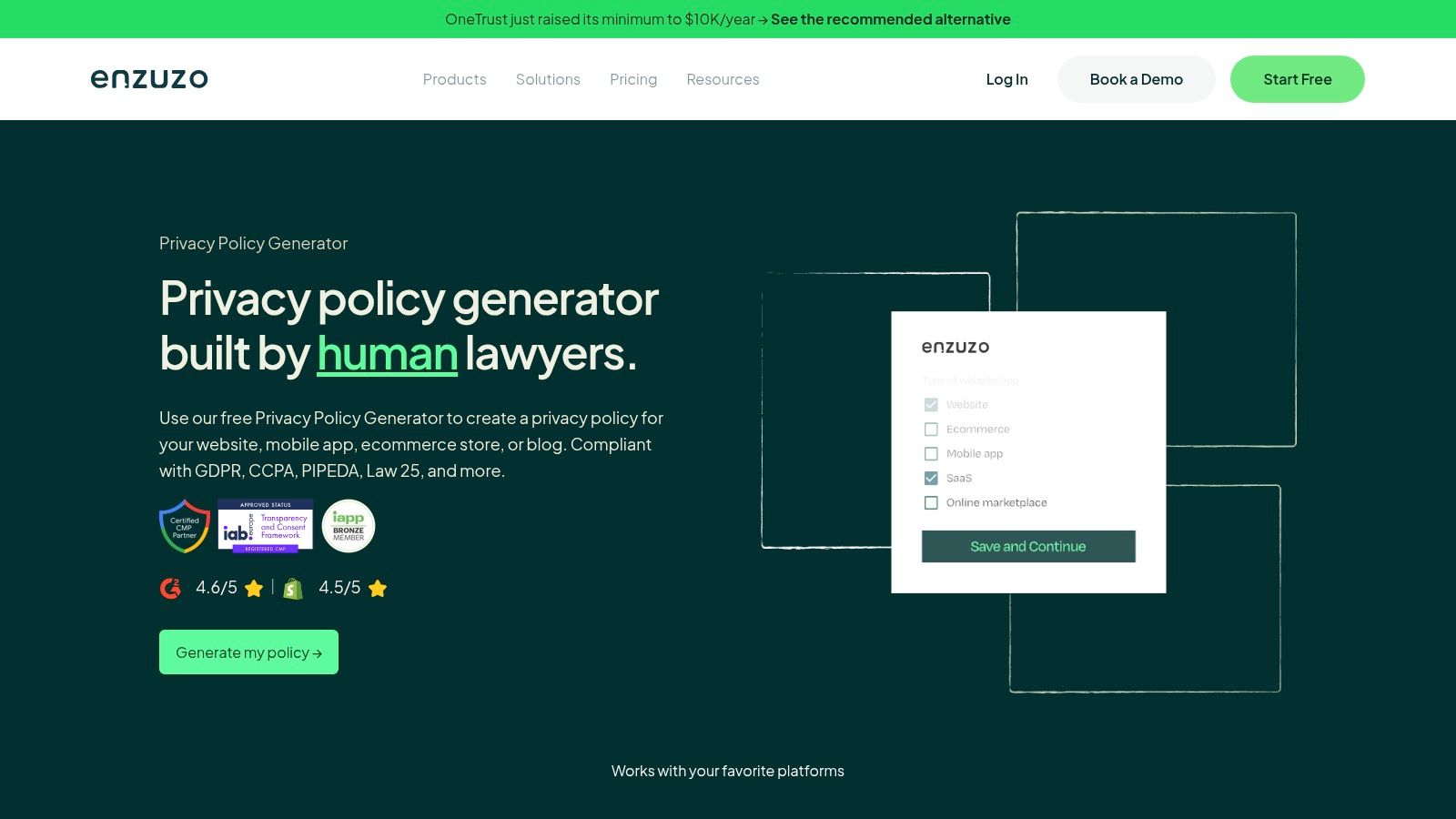
Enzuzo's Privacy Policy Generator combines policy generation with a consent management platform. It provides hosted, automatically updated policies, cookie-banner capabilities, Google Consent Mode v2 support, DSAR workflows, compliance reporting, and multilingual support in 25+ languages, according to the product information supplied for this comparison.
That makes Enzuzo more relevant to a growing web app than a document-only generator. A company can publish its privacy policy, configure consent, and give users a route for exercising privacy rights from a broader dashboard. E-commerce-oriented features also help teams whose applications combine accounts, orders, marketing, and customer data.
<a id="strong-operational-coverage-with-a-customization-boundary"></a>
Strong operational coverage with a customization boundary
Enzuzo's value appears after publication. Cookie consent and DSAR handling are recurring workflows, not launch-day documents, so keeping those functions near the policy can reduce tool sprawl. Multilingual support is also useful when a product serves users across language markets.
The compromise is that a CMP-first product may not offer the same depth of legal customization as a clause-centric generator. Some advanced controls, branding removal, and higher DSAR limits are paid. Teams with unusual processing arrangements should review the generated language rather than assuming that automatic updates cover product-specific details.
A consent banner can record a choice, but it can't make an inaccurate data inventory accurate.
Before implementation, test the banner in the actual web app, including authenticated routes and embedded third-party components. Confirm that nonessential scripts wait for the appropriate consent state and that the policy explains the purposes represented in the consent interface.
Enzuzo fits a mid-market team that wants policy hosting, consent controls, and rights workflows in one place. It's more infrastructure than a basic prototype needs, but the operational focus becomes valuable once privacy requests and tracking preferences require regular attention.
<a id="8-termageddon-auto-updating-policies"></a>
8. Termageddon Auto-Updating Policies
Termageddon treats policy creation as an ongoing maintenance process. Its questionnaire maps relevant laws and disclosures, then supports updates to Privacy Policies, Terms, Cookie Policies, EULAs, and related documents. Email alerts notify the account owner when a policy needs attention.
For a web app launch, this model reduces the work of monitoring legal changes manually. It also suits products that need several legal pages managed together. A single license can cover multiple policy types for one site or app, according to the supplied product notes.
The subscription is the main trade-off. A small project that wants a one-time purchase may prefer TermsFeed or PrivacyPolicies.com. A production app serving several regions may accept recurring cost in exchange for an established update process. Hosting and embedding still require implementation work, so teams should confirm how policies will appear in the app, onboarding flow, and launch materials.
Auto-updating language does not replace a current data inventory. If the app adds an analytics provider, changes account deletion, introduces marketing features, or collects a new category of information, someone must revise the questionnaire answers. The service cannot detect product changes that the team never reports.
Before launch, assign an owner for policy reviews and test every linked document from the live app. Check that disclosures match the actual processors, cookies, account flows, and consent choices. For unusual processing, regulated data, or a launch across multiple legal regimes, have qualified legal counsel review the generated text.
Termageddon fits a team that:
- Needs continuing policy maintenance: The business wants a process for updates instead of a static document.
- Publishes several legal pages: Terms, cookie disclosures, and related documents can follow one maintenance model.
- Expects product or market changes: The team can revisit its answers as features, regions, and data practices evolve.
It may be more than a simple prototype requires. For a production SaaS app with multiple processors and an assigned compliance owner, its update-focused workflow is more practical than treating policy generation as a finished launch task.
<a id="9-cookieyes-privacy-and-cookie-policy-generators"></a>
9. CookieYes Privacy and Cookie Policy Generators
CookieYes is strongest when cookie compliance and consent are central to the launch. Its dashboard includes Privacy Policy and Cookie Policy generators alongside a consent management platform, cookie scanning, Consent Mode v2, and IAB TCF 2.3 support. Platform guidance helps teams embed policies into environments such as WordPress and Shopify.
That focus changes how you evaluate the product. The key question isn't just whether the generated policy contains the right headings. It's whether the scanner, banner, policy, and website implementation describe the same cookies and processing purposes.
<a id="best-for-tracking-heavy-websites"></a>
Best for tracking-heavy websites
CookieYes has an approachable interface and includes policy generation within a broader cookie workflow. That can reduce the work required to deploy a banner and connect consent decisions with tracking technologies. Active product updates and platform documentation also help developers who don't want to build every integration from scratch.
The generator itself is lighter than a clause-based service. Teams with complicated data processing may need to supplement the generated text with manual edits or another legal review. Some advanced features are limited to higher tiers, so confirm that the selected plan supports the app's domains, scan requirements, and consent configuration.
Use CookieYes when the web app relies heavily on analytics, advertising, or embedded services. Start by scanning the production-like environment, then compare the findings against the questionnaire and policy. Test both first-visit behavior and returning-user preferences, because a banner that appears correctly doesn't prove that consent signals reach every tag.
CookieYes is less compelling when the product collects little data and doesn't use nonessential cookies. In that case, a lightweight generator may be faster. For a marketing-led application with active tracking, the integrated consent workflow is the more important feature.
<a id="10-app-privacy-policy-generator-by-nisrulz"></a>
10. App Privacy Policy Generator by Nisrulz
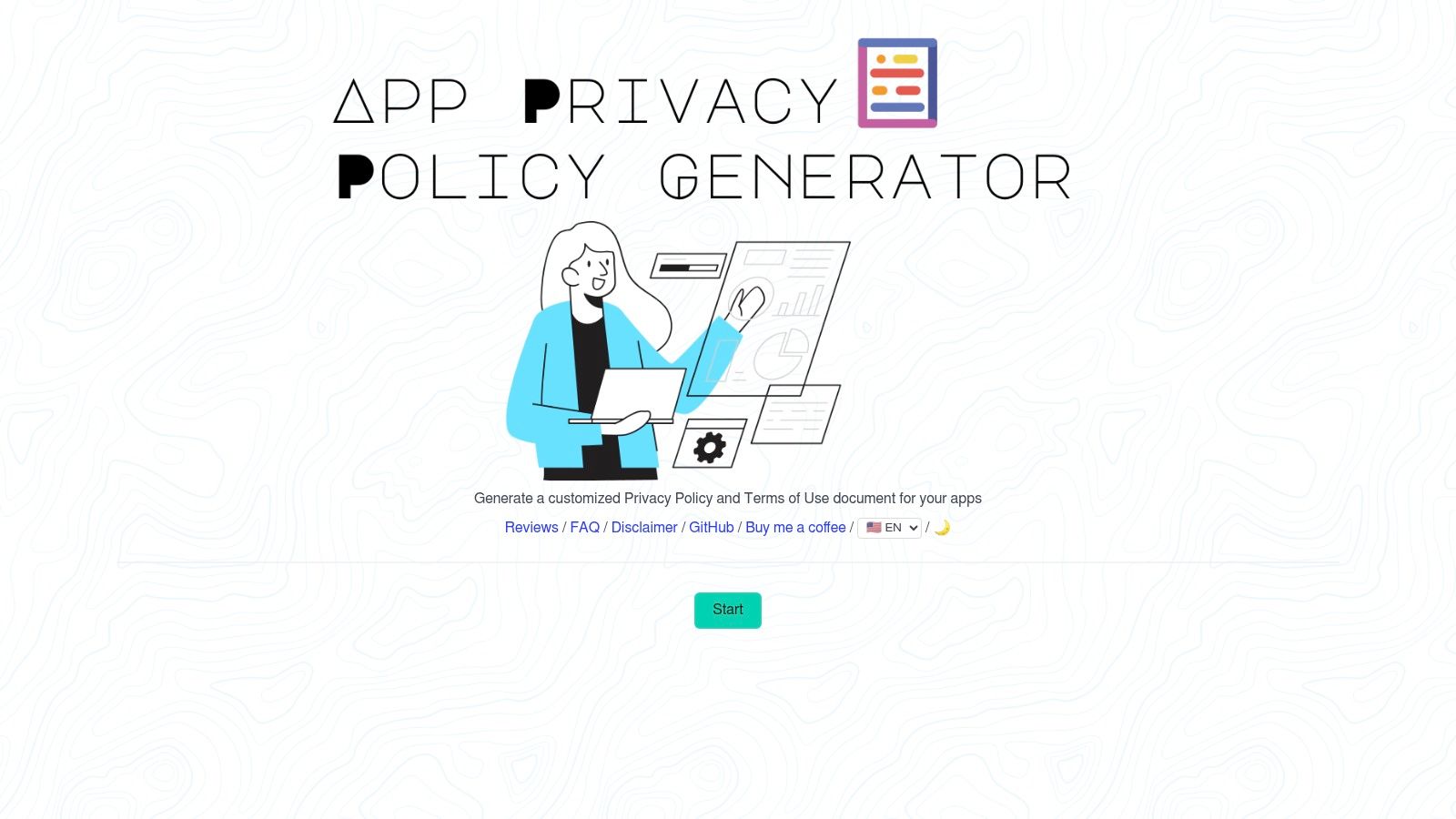
A generated policy can help a web app reach launch, but it cannot verify the app's data practices. App Privacy Policy Generator by Nisrulz is a free, open-source tool designed for fast output. Its mobile-first questionnaire covers platform, monetization, tracking, and GDPR-related options, then exports HTML or Markdown. No signup is required, so a developer can produce copy-ready text while preparing an early release.
The mobile focus limits how well it maps to a web app with accounts, analytics, embedded services, or several processing purposes. For a prototype or indie product with straightforward data collection, the result can support a public policy route. A production application should treat it as a starting document, then compare each answer with the live code and vendors.
<a id="useful-during-a-launch-not-a-compliance-system"></a>
Useful during a launch, not a compliance system
The workflow is quick: select applicable options, copy the generated text, host it on a controlled URL, and include that URL in the website or product materials. Open-source, no-signup access also suits experiments where paying for a compliance platform would add unnecessary cost.
Hosting remains your responsibility. So do policy updates, consent handling, data-subject request workflows, and checks after adding a vendor or feature. The tool does not provide bundled cookie consent, hosted compliance management, DSAR workflows, automatic legal review, or change tracking for the application. It also cannot resolve complex processing arrangements or replace qualified legal advice.
Before publishing, verify three launch dependencies:
- Platform consistency: Describe the actual web and mobile surfaces in scope.
- Tracking accuracy: Compare analytics, advertising, crash-reporting, and attribution selections with the implementation.
- Store and website alignment: Use the same data inventory in product disclosures and submission materials.
A large-scale 2024 study of 99,194 Android apps found that 15.7% had no privacy policy. Among 46,472 valid Google Play privacy policy documents, about 20.1% were judged likely to have been generated by existing generators. The study identified App Privacy Policy Generator as the most popular examined generator, with a 72.7% adoption rate among examined generators. The TermsFeed summary of the study reports those findings. Popularity does not establish completeness. Use Nisrulz for a bounded launch when the data model is simple, and obtain legal review when the app handles sensitive data, complex vendors, or multiple regulatory obligations.
<a id="top-10-web-app-privacy-policy-generators-feature-comparison"></a>
Top 10 Web App Privacy Policy Generators, Feature Comparison
| Tool | Core features | UX ★ | Value 💰 | Audience 👥 | Standout ✨🏆 |
|---|---|---|---|---|---|
| Termly, Privacy Policy Generator | Hosted policies; cookie consent (Consent Mode v2); legal updates; single dashboard | ★★★★ | 💰 Free tier; paid plans for advanced features | 👥 SMBs, indie devs | ✨ Easy non‑technical setup; unified policies + consent |
| iubenda, Privacy & Cookie Policy Generator | Clause‑based generator; service‑aware clauses; multilingual hosting; consent tools | ★★★★★ | 💰 Modular pricing; per‑site/app fees can add up | 👥 Agencies, global businesses | ✨ Thousands lawyer‑crafted clauses; 🏆 best for complex/global needs |
| TermsFeed, Privacy Policy Generator | Free base generator + paid GDPR/CCPA add‑ons; multiple policy types; host or download | ★★★★ | 💰 Free base; predictable one‑time add‑ons | 👥 SMBs, app owners | ✨ Straightforward flow; clear platform hosting options |
| GetTerms, Privacy Policy Generator | Simple templates (Standard/Comprehensive); copy/download; quick setup for apps/web | ★★★★ | 💰 Transparent, low pricing tiers | 👥 Developers, quick launches | ✨ Fast, developer‑friendly; minimal friction |
| PrivacyPolicies.com, Privacy Policy Generator | Free hosted policy + one‑time add‑ons; multiple legal doc types; mobile/app coverage | ★★★★ | 💰 Free base; many one‑time add‑ons (no recurring) | 👥 Small businesses, app/web owners | ✨ Wide doc types; one‑time purchase model |
| FreePrivacyPolicy.com, Free Privacy Policy Generator | Free basic policy generator; supports other docs; copy/paste & self‑host options | ★★★ | 💰 Truly free entry; paid upgrades available | 👥 Prototypes, MVPs, side projects | ✨ Zero‑friction, quick policy URL |
| Enzuzo, Privacy Policy Generator + CMP | Policy generator + CMP; auto updates; DSAR forms; 25+ languages; hosting | ★★★★ | 💰 Free‑forever to paid tiers; good mid‑market value | 👥 SMBs, e‑commerce, multilingual teams | ✨ DSAR workflows; Google Consent Mode v2; 🏆 CMP alternative for SMBs |
| Termageddon, Auto‑Updating Policies | Auto‑updating policies; questionnaire maps laws; email update notices; cookie consent | ★★★★ | 💰 Subscription model (ongoing updates) | 👥 Sites/apps needing continuous compliance | ✨ Auto‑updates for changing laws; 🏆 strong U.S. state coverage |
| CookieYes, Privacy & Cookie Policy Generators + Consent | CMP with cookie scanner; Consent Mode v2 & IAB TCF 2.3; policy generator + hosted pages | ★★★★ | 💰 Free trial; paid plans for advanced features | 👥 Sites with heavy cookie/consent needs | ✨ Best cookie tooling; platform integration guides |
| App Privacy Policy Generator (by Nisrulz) | Mobile‑first workflow (platform, monetization, tracking); HTML/Markdown export; open‑source | ★★★ | 💰 Free, open‑source | 👥 Indie app devs, prototypes | ✨ App‑store‑ready policies; no signup, super fast |
<a id="choose-the-generator-that-matches-your-launch-risk"></a>
Choose the Generator That Matches Your Launch Risk
A privacy policy generator should match the application's data complexity, launch surface, and maintenance capacity. Start with the smallest tool that can accurately describe the product, then move up when the workflow requires continuous updates, consent controls, multilingual documents, or rights-request handling.
For a simple prototype, a lightweight generator such as FreePrivacyPolicy.com or the Nisrulz tool may be enough. That assumes limited data practices, a small vendor stack, and an owner who will publish the result and review it when the product changes. GetTerms and PrivacyPolicies.com offer a similarly direct path when you want more structured policy options without adopting a full consent platform.
A clause-based service such as iubenda becomes more appropriate when the app uses multiple SDKs, processors, regions, or languages. Termageddon is a better fit when ongoing legal updates and several policy types matter more than a one-time purchase. Termly, Enzuzo, and CookieYes make more sense when consent management, cookie behavior, or subject-rights workflows are central to the product.
The underlying problem is alignment. Independent research found that generator output quality varies by tool, and a readability benchmark reported Flesch Reading Ease scores of 45.5 for a Moodle policy, 39 for a Termly-generated policy, and 37.4 for PPGen/TermsFeed, with the generated examples remaining difficult to read. The evaluation published on arXiv shows why a policy should be reviewed for clarity, not just generated and published.
A launch review should cover:
- Data inventory: Record account fields, payment information, identifiers, device data, logs, location data, support messages, and any sensitive categories the app handles.
- SDK and vendor disclosures: Compare the policy with analytics, advertising, authentication, payments, hosting, monitoring, email, chat, and customer-support services used.
- Consent behavior: Confirm which cookies and trackers require consent, whether scripts wait correctly, and whether users can change preferences later.
- Children's data: Consider whether children may use the product and whether additional safeguards, notices, or age-related controls apply.
- Policy URL placement: Link the policy from the website, sign-up experience, account settings, support area, and any store submission field that requests it.
- Hosting ownership: Document who controls the hosted page, how the team will update it, and what happens if the generator account is closed.
- Store materials: Keep the policy, app disclosures, Google Play Data Safety questionnaire, Apple privacy details, permissions, and SDK inventory consistent.
- Change monitoring: Trigger a review when the team adds a tracker, changes a vendor, introduces advertising, expands regions, or changes retention and deletion behavior.
- Legal review: Ask a qualified privacy lawyer to review the result when the app processes sensitive information, targets children, profiles users, operates across complex jurisdictions, handles substantial payments, or has unusual data-sharing arrangements.
The operational gap between a stand-alone policy and store disclosures deserves special attention. Google Play can cross-check a privacy policy against the separate Data Safety questionnaire, and mismatches can create launch problems. A policy generator may help with form-filling guidance, but the team still needs to keep the policy, SDK inventory, permissions, analytics configuration, advertising setup, and store forms aligned as the app changes. Newly's app privacy policy generator guidance reflects this shift from static text toward compliance mapping.
For React Native and Expo teams preparing a store launch, LetsDeployIt can fit into the final workflow by helping prepare and host privacy policies and Terms alongside store assets, compliance checks, reviewer notes, and submission management. It can also help connect the actual privacy-policy URL and compliance details to the App Store and Google Play release process. That service doesn't replace legal advice, and the product team still needs to provide accurate data-practice information.
Choose the generator, publish the policy, and then assign ownership for keeping it accurate. A fast document solves the first launch task. A maintained, readable, technically aligned policy supports the product after release.
LetsDeployIt helps React Native and Expo teams prepare app-store launch materials, host privacy policies and Terms, check compliance details, and manage submissions. Visit LetsDeployIt to connect your policy workflow with the rest of your App Store and Google Play launch.